From Ten Days to Ten Minutes: Reviewing a Half-Million-Line Skia Bump
April 2026 — Matthew Leibowitz (@mattleibow)
Let me tell you about my least favourite week of every quarter.
SkiaSharp is the .NET binding for Skia — Google’s 2D graphics engine that powers Chrome, Android, Flutter, and a long list of UI frameworks including .NET MAUI. Every few months, Google ships a new Skia milestone, and somebody (usually me) has to pull it in. That “somebody” then opens a pull request that looks something like this:
changed 4,217 files with 487,902 additions and 312,884 deletions
Yes, really. Half a million lines. C++, headers, build files, vendored third-party code, regenerated P/Invoke bindings, an upstream merge with hundreds of commits, and a pile of our own carry-patches that may or may not still apply. And it’s not even one PR — it’s two: one in mono/skia, and a companion in mono/SkiaSharp for the C# side. They have to be reviewed together or not at all.
For years, doing this review properly meant blocking out the better part of two weeks and working through it by hand:
- Pull both branches locally and build them, because the GitHub diff viewer gives up long before file 4,000.
- Walk the upstream merge commit by commit — hundreds of them — to understand what Google actually changed across fourteen Skia milestones.
- For every one of our carry-patches, work out whether it was preserved, rebased, upstreamed, obsoleted, or silently dropped. Miss one and we ship a regression to every customer using SkiaSharp.
- Re-run the P/Invoke binding generator from scratch and diff the output against what’s in the PR, header by header, to make sure the C# surface still matches the new C ABI.
- Cross-reference every
DEPSbump (freetype, libjpeg-turbo, harfbuzz, and friends) against the Chromium revision it’s supposed to track, and check the changelogs for anything security-sensitive. - Switch over to the companion C# PR and audit the hand-written changes for null handling, disposal, and backward compatibility — separately from the auto-generated bindings, because mixing those two reviews is how mistakes happen.
Each of those steps requires real focus, and you cannot safely interleave them — lose your place in the merge graph and you start over. Customers — Chrome’s .NET ecosystem, MAUI apps in production, every shipped game and design tool that links SkiaSharp — depend on this review being thorough, so cutting corners is not an option. The realistic cost was about ten working days of one person’s undivided attention, and during that time almost nothing else got done.
The Real Questions Hiding in That Diff
Here’s the thing — buried under all those generated files and submodule churn, the questions a reviewer actually needs to answer are tiny:
- Did the upstream merge bring in the commits we think it brought in?
- Are any of our local patches missing — and if they’re gone, were they upstreamed, or did somebody just delete them?
- Do the regenerated P/Invoke bindings actually match the new C headers, byte-for-byte?
- Did
DEPSquietly move a third-party library (freetype, libjpeg-turbo, …) to a commit nobody audited? - On the C# side, are null handling, disposal, and ABI compatibility still correct?
Five questions. Half a million lines. You do the math.
Enter the Skill
So we built a review-skia-update skill that lives in the SkiaSharp repo. I run one command, the AI does the boring mechanical work (regenerating bindings, walking the upstream merge, diffing DEPS), and out the other end pops a single self-contained HTML file.
That HTML file is the whole point of this post. Let me show you.
The Report
When the run finishes, I open the report in my browser and see this:
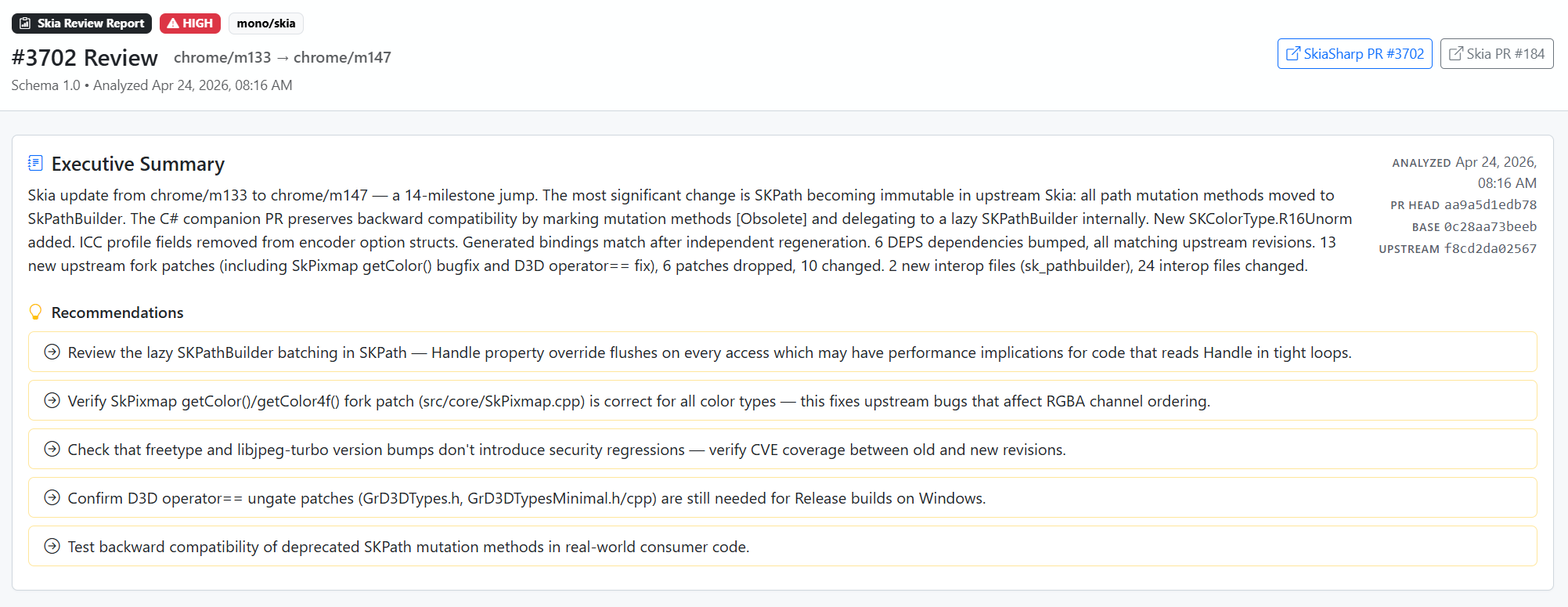
In the time it takes to read one paragraph, I already know:
- What this PR is. “Skia update from chrome/m133 to chrome/m147 — a 14-milestone jump.” Fourteen milestones! That used to be a “block off the calendar” kind of PR.
- What actually changed at the architectural level. “SKPath becoming immutable in upstream Skia… The C# companion PR preserves backward compatibility by marking mutation methods
[Obsolete]and delegating to a lazy SKPathBuilder internally.” That is the single most important sentence in the entire 500K-line diff, and it’s right at the top. - What I should personally double-check. A short, ranked list of recommendations: verify the
SkPixmap.getColor()fork patch, check thatfreetypeandlibjpeg-turbobumps don’t introduce CVE regressions, confirm the D3Doperator==ungate patches are still needed, test backward compatibility of the now-deprecatedSKPathmutation methods. - The risk level. A big red HIGH badge in the corner. No ambiguity.
- A receipt. PR HEAD, BASE, and upstream SHAs printed right there, so I can reproduce the analysis or argue with it later.
That’s the executive summary. Then come the tabs.
The “Upstream” Tab — Where the Magic Lives
The tabs along the bottom are the real superpower. Generated Files (0 issues — bindings regenerated and matched). Interop (26 things to look at). DEPS (6 third-party bumps). Companion PR (27 C# items). And the one I always click first: Upstream — 29 items.
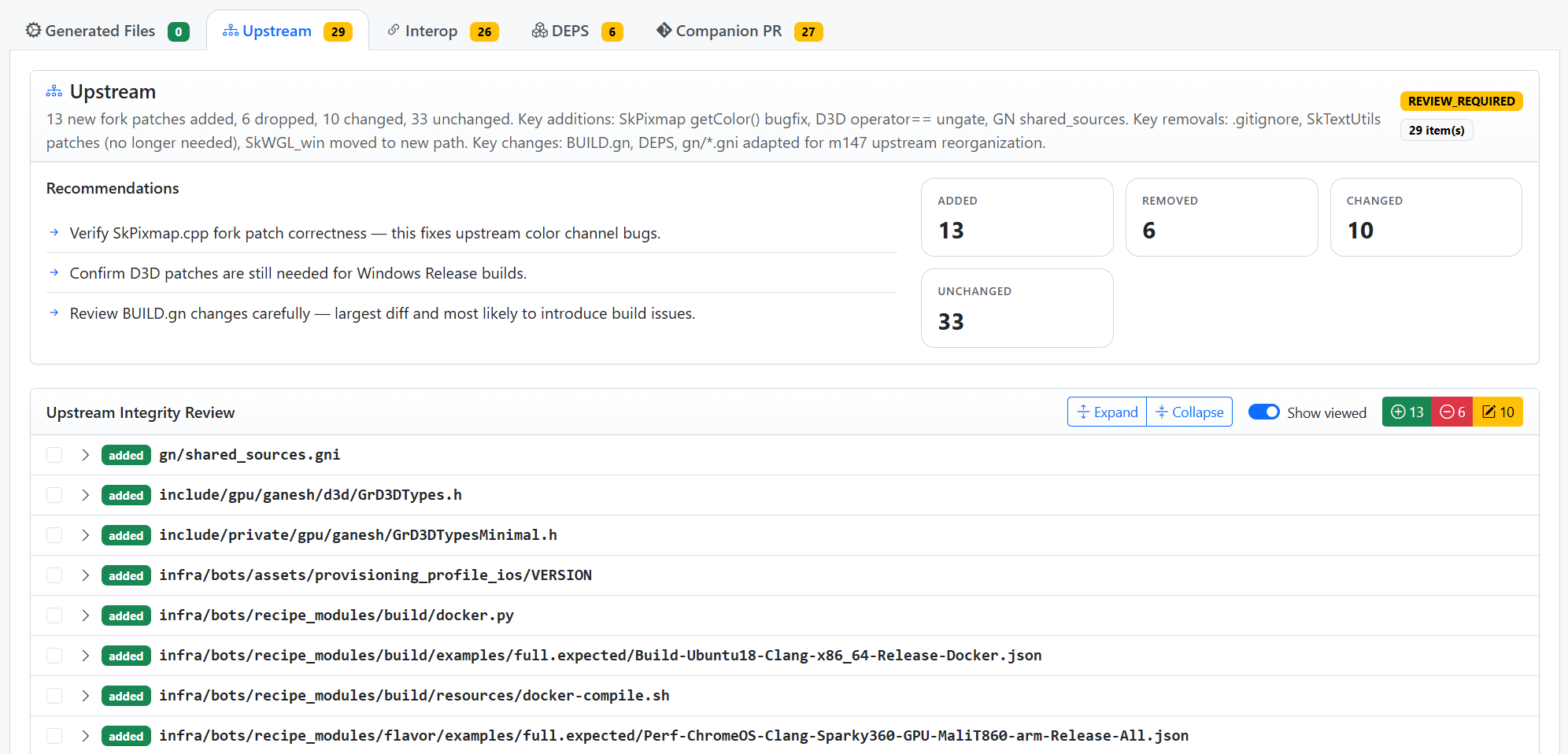
This tab answers the question that used to keep me up at night: what actually happened to our carry-patches? For every patch on top of upstream Skia, the report tells me whether it was added, removed, changed, or unchanged — and for each one, a one-paragraph summary of why. Was it upstreamed? Obsoleted by a refactor? Quietly dropped? The skill is required to look at the new upstream code and explain; it’s not allowed to shrug.
Click any item and the actual diff expands inline (it’s powered by diff2html), so I can verify the AI’s summary against the real code without leaving the page. No git checkouts. No gh pr view. No twelve browser tabs.
Same story for the other tabs:
- Generated Files — the skill regenerates the P/Invoke bindings from scratch and diffs them against what’s in the PR. If the author’s bindings don’t match, that’s a real signal, not a vibe check. In this PR: a clean PASS, 0 mismatches.
- DEPS — every third-party submodule bump, with the old SHA, the new SHA, and a note about whether it matches the upstream Chrome revision.
- Companion PR — only the hand-written C# changes, because the auto-generated
*Api.generated.csfiles were already validated mechanically.
Every section has a count badge. Every item has a diff. Nothing requires me to remember anything.
Why This Changes Everything
I want to be clear about what the AI is and isn’t doing here, because that’s the part I think people get wrong.
The AI is not approving my PR. It never says “this file is fine, ship it.” There’s an explicit rule in the skill: no per-file PASS/FAIL. The job of the AI is to make my review tractable, not to replace it.
The AI is not guessing. The mechanical checks are mechanical — a Python script regenerates bindings, runs diff, walks the merge graph. The AI only narrates the results and ranks the risk. If a binding doesn’t match, that’s diff saying so, not a language model having a feeling.
The AI is doing the part I was bad at. I am a human. I cannot read 4,000 files. I cannot remember which of our 80-odd carry-patches were added in 2019 and why. I cannot eyeball whether a regenerated P/Invoke signature drifted by one parameter. The computer is great at all of those things, and now it does them in about ten minutes instead of me doing them badly over ten days.
The before-and-after is stark:
| Before | After | |
|---|---|---|
| Time to first useful review | ~10 days | ~10 minutes |
| Files I personally scroll through | thousands | dozens |
| “Did I miss a dropped patch?” anxiety | constant | zero |
| Reviewers willing to look at the PR | 1 (me, reluctantly) | anyone with a browser |
That last row matters more than the others. The HTML report is a single self-contained file. I can drop it in a gist, paste the link in a PR comment, and now anybody on the team can meaningfully review a Skia bump — not just the one person who has memorised the layout of the repo. The knowledge isn’t in my head anymore; it’s in the report.
Steal This Pattern
If you maintain anything with a “huge regenerated PR” problem — a vendored library, a generated SDK surface, a regenerated gRPC or OpenAPI client, a giant codegen artifact — this pattern works. The recipe is short:
- Write down the five questions a reviewer actually needs to answer.
- Make a script that mechanically answers the ones a script can answer.
- Have the AI narrate the results and flag the items a human still needs to look at.
- Render it as one HTML file you can share.
That’s it. The skill is a markdown file. The orchestrator is a Python script. The “magic” is just deciding, up front, what a good review looks like — and then refusing to ship a report that doesn’t deliver one.
What used to be a multi-day, focus-eating slog is now a focused, repeatable process. A new Skia milestone lands, I run the skill, and within minutes I have a structured report that lets me — or any other reviewer — give the change the attention our customers deserve.
Links
mono/SkiaSharp—review-skia-updateskill- Live sample report (open in a browser)
- SkiaSharp — .NET bindings for Skia